
Graphing Quadratic Functions & Forms: Guided Study Guide & Practice Packet
On Sale
$3.00
$3.00
Master Quadratic Functions and Their Graphs: Standard, Vertex, and Factored Forms
Provide your students with a structured, visual, and step-by-step approach to understanding and graphing quadratic functions. This comprehensive 11-page packet bridges conceptual understanding with procedural fluency, walking learners through key algebraic characteristics, transformation mechanics, and graphing strategies across all three primary quadratic forms.
What is Included:
- Visual Anchor Charts & Concept Guides:
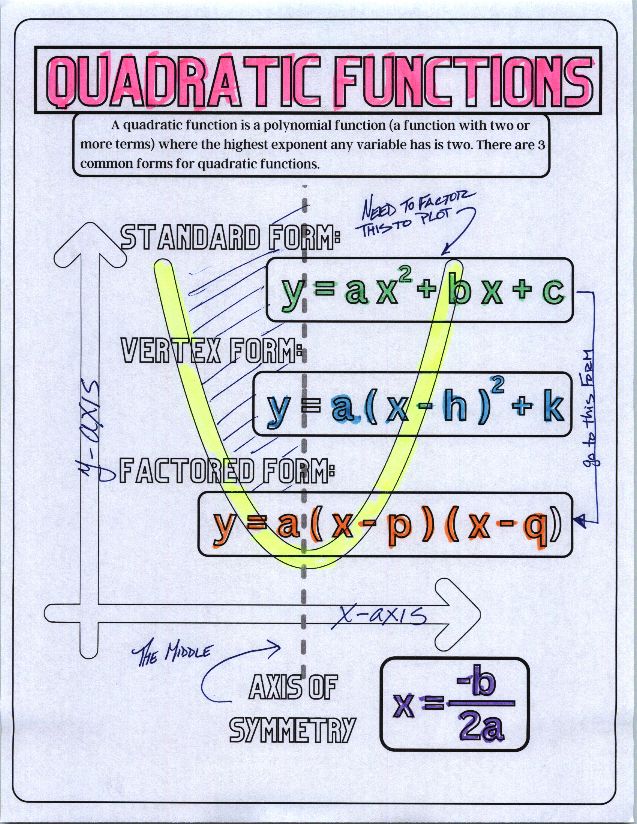
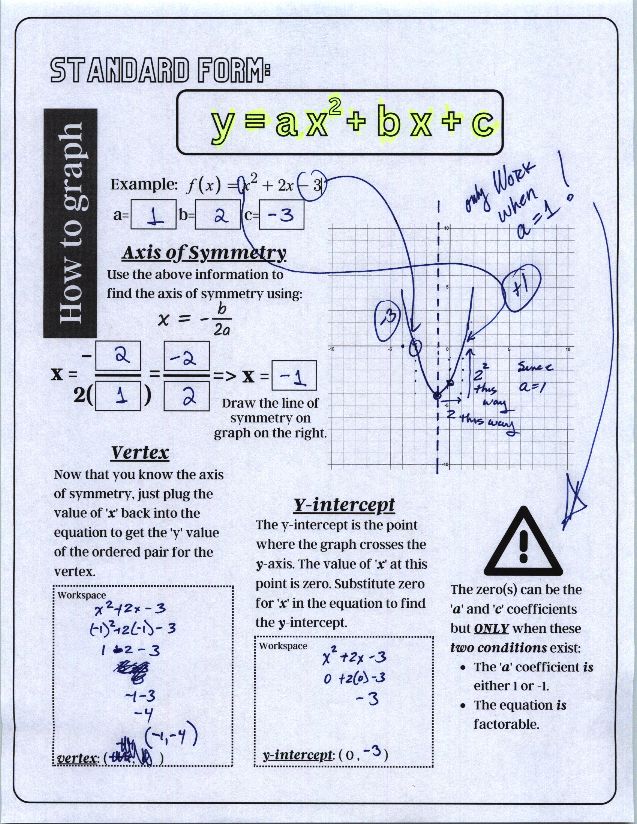
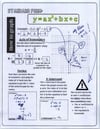
- Standard Form (y = ax² + bx + c): Step-by-step calculation of the axis of symmetry (x = -b / (2a)), vertex identification via substitution, and finding the y-intercept.
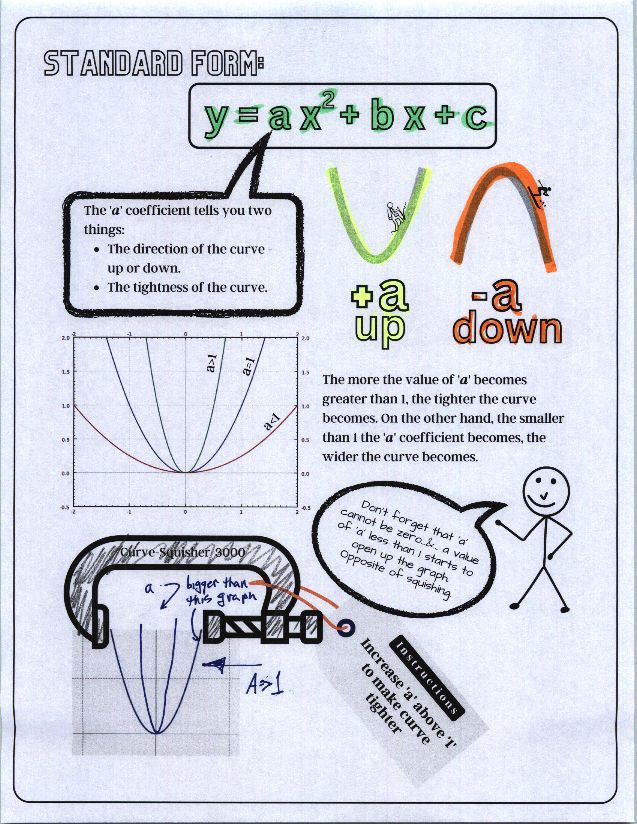
- The Role of the 'a' Coefficient: Clear visual models illustrating vertical stretches, compressions ("tighter" vs. "wider" curves), and upward/downward concavity.
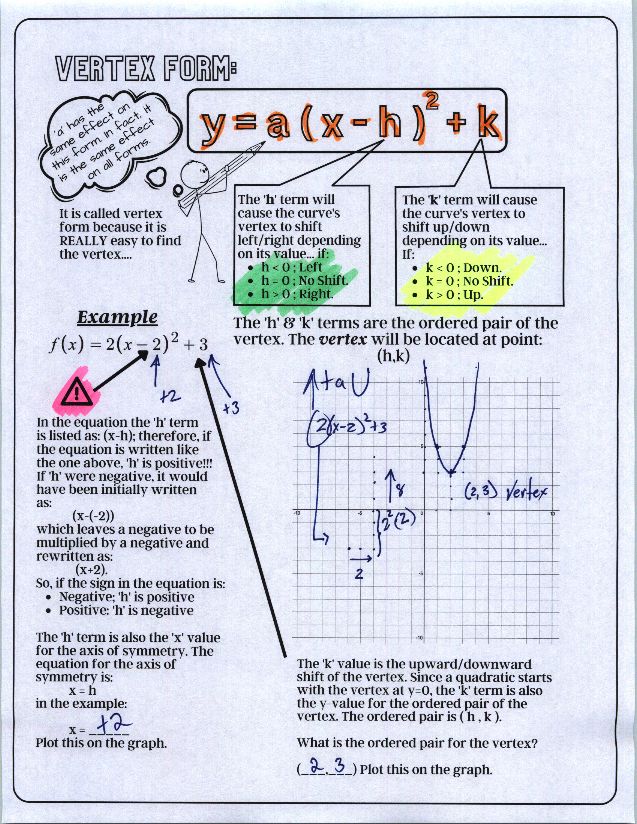
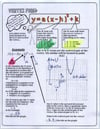
- Vertex Form (y = a(x - h)² + k): Intuitive breakdown of horizontal and vertical shifts (h and k), avoiding sign confusion with (x - h), and reading coordinates directly from equations. Includes common iteration notes when parameters equal 0 or 1.
- Factored Form (y = a(x - p)(x - q)): Utilizing the Zero Product Property to identify roots/zeros, determining the axis of symmetry midway between intercepts, and solving for the vertex.
- Targeted Practice Problem Sets:
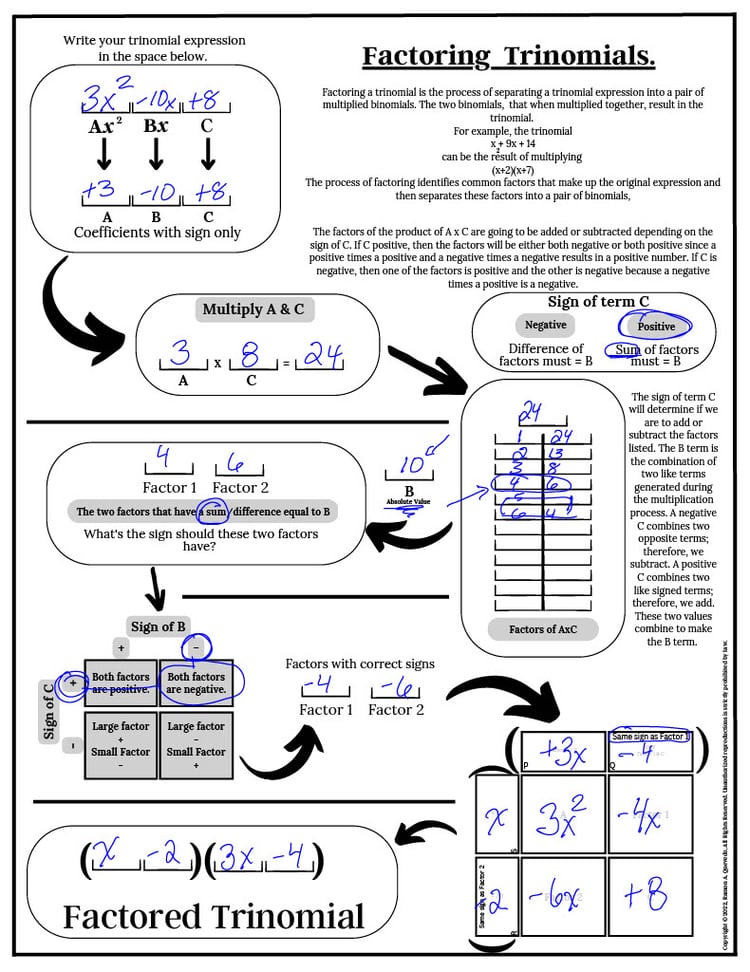
- Standard Form Analysis & Factoring: Identifying roots, axis of symmetry, vertex, and intercepts from quadratic expressions.
- Factored Form Practice: Finding zeros, midpoints, and sketching parabolas.
- Vertex Form Table Work: Identifying axis of symmetry, vertex coordinates, and y-intercepts across varied algebraic setups.
- Full Answer Keys:
- Complete reference keys included for quick grading, self-checking, or guided classroom review.
Format: Ready-to-print 11-page PDF packet with built-in workspace grids and coordinate planes for immediate classroom, small group, or homeschool use.
Standards Alignment
Texas Essential Knowledge and Skills (TEKS) — Algebra 1:
- A.6(A): Determine the domain and range of quadratic functions and represent them using inequalities.
- A.6(B): Write equations of quadratic functions given the vertex and another point on the graph, write the equation in vertex form (f(x) = a(x - h)² + k), and rewrite the equation from vertex form to standard form (f(x) = ax² + bx + c).
- A.7(A): Graph quadratic functions on the coordinate plane and use the graph to identify key attributes, if possible, including x-intercept, y-intercept, zeros, maximum value, minimum values, vertex, and the equation of the axis of symmetry.
- A.7(B): Describe the relationship between the linear factors of quadratic expressions and the zeros of their associated quadratic functions.
- A.7(C): Determine the effects on the graph of the parent function f(x) = x² when f(x) is replaced by af(x), f(x) + d, f(x - c), f(bx) for specific values of a, b, c, and d.
Common Core State Standards for Mathematics (CCSS-M):
- HSA.SSE.B.3.A: Factor a quadratic expression to reveal the zeros of the function it defines.
- HSA.SSE.B.3.B: Complete the square in a quadratic expression to reveal the maximum or minimum value of the function it defines.
- HSF.IF.C.7.A: Graph linear and quadratic functions and show intercepts, maxima, and minima.
- HSF.IF.C.8.A: Use the process of factoring and completing the square in a quadratic function to show zeros, extreme values, and symmetry of the graph, and interpret these in terms of a context.
- HSF.BF.B.3: Identify the effect on the graph of replacing f(x) by f(x) + k, k · f(x), f(kx), and f(x + k) for specific values of k (both positive and negative); find the value of k given the graphs.