
Introduction to Transistors: NPN Transistor Switch Breadboard Lab & Student Assessment
Demystify semiconductor electronics with this complete, hands-on instructional packet and breadboard lab! Designed for introductory electronics, CTE engineering, physical science, and STEM classrooms, this activity walks students step-by-step through how an NPN bipolar junction transistor (BJT) functions as an electronic switch.
Click on Preview above to see all pages.
What’s Included:
- Illustrated Conceptual Guides:
- The Transistor: A Tiny Giant of Technology: Covers core definitions, real-world applications (computers, smartphones, automotive, and medical tech), and why transistors are the foundation of modern electronics.
- How a Transistor Works (The Water Faucet Analogy): Breaks down semiconductor layers, base-control mechanics, and switching states in an intuitive, accessible manner.
- NPN Transistor Component Breakdown: Explains the emitter, base, and collector roles, as well as the essential difference between conventional current flow and actual electron flow in circuit schematics.
- Hands-On Breadboard Lab Activity:
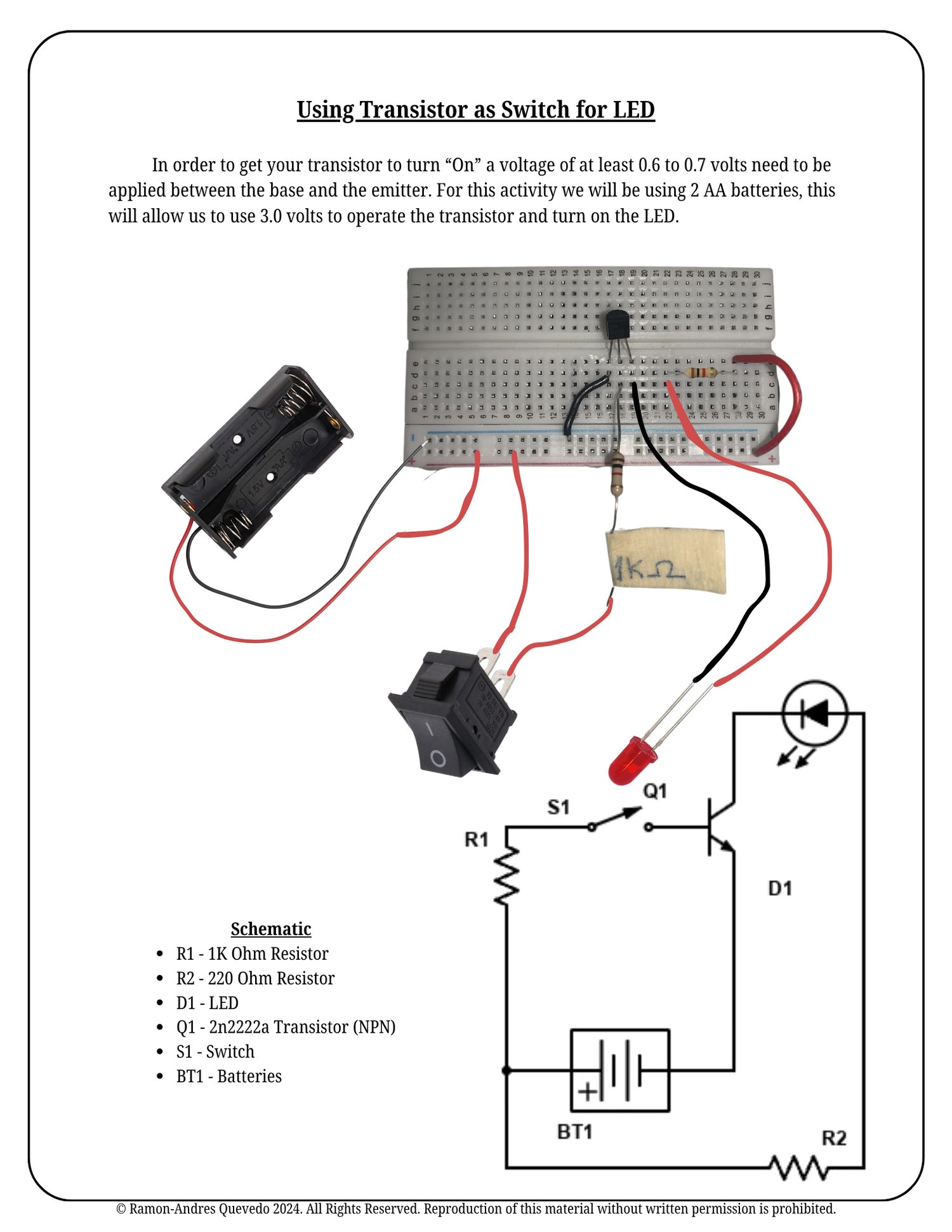
- Complete bill of materials using accessible components (2N2222 NPN transistor, breadboard, resistors, switch, AA power source, and LED).
- Clear schematic diagrams, component pinouts (TO-92 package), maximum voltage/current specs, and full-color breadboard wiring photos.
- Guides students through calculating base-emitter turn-on voltage (0.6V–0.7V) and wiring a transistor to control an LED circuit.
- Student Assessment & Practice Worksheet:
- Fill-in-the-Blank: Reinforces vocabulary (semiconductor, base, collector, emitter, volt, amp) using a word bank.
- Multiple Choice: Tests core concepts, current flow directions, and device functionality.
- Open-Ended Conceptual Questions: Prompts students to explain analogical thinking (faucet model) and the significance of semiconductors.
- Complete Teacher Answer Key: Full solutions for all fill-in-the-blank, multiple-choice, and short-answer prompts for fast grading or self-checking.
Classroom Integration & Standards:
- Target Grade Levels: 8th–12th Grade
- Subject Areas: Career & Technical Education (CTE), Digital Electronics, AC/DC Electronics, Principles of Applied Engineering, Physics, and High School Maker Labs
- Format: Ready-to-print PDF packet (Student Handouts, Lab Manual, and Answer Key)
Texas Essential Knowledge and Skills (TEKS) Alignment
1. AC/DC Electronics (19 TAC §130.368) / Career & Technical Education (CTE)
TEKS §130.368(c)(5): The student demonstrates knowledge of basic electronics and electrical theory.
(C) Identify and explain the purpose and operation of discrete semiconductor devices, including diodes and bipolar junction transistors (BJTs).
(D) Interpret electronic schematic symbols, component diagrams, and designations.
(E) Construct, test, and troubleshoot basic direct current (DC) circuits containing resistors, switches, solid-state switches (transistors), and light-emitting diodes (LEDs) using standard breadboarding techniques.
TEKS §130.368(c)(6): The student uses standard test equipment and circuit measurement techniques.
(A) Safely configure and use digital multimeters (DMMs) to measure voltage, resistance, and current (milliamperes).
(B) Differentiate between conventional current flow and electron flow in DC circuit analysis.
2. Digital Electronics (19 TAC §130.375) / Principles of Applied Engineering
TEKS §130.375(c)(4): The student understands the hardware foundation of binary logic and switching.
(A) Analyze the transistor's role as the fundamental building block and electronic switch in digital logic, computing devices, and microprocessors.
(B) Calculate and verify base saturation/threshold requirements ($V_{BE} \approx 0.6\text{V} - 0.7\text{V}$) to drive solid-state switching states (ON/OFF).
3. High School Physics (19 TAC §112.39)
TEKS §112.39(c)(5): Science concepts. The student knows the characteristics and behaviors of electricity and magnetism.
(D) Investigate and evaluate electric current, potential difference (voltage), and resistance in series and parallel circuits.
(F) Analyze how semiconductor components regulate charge flow and transfer electrical energy into radiant energy (LEDs).
National Educational Standards Alignment
1. Next Generation Science Standards (NGSS)
HS-PS3-3 Energy:
Standard: Design, build, and refine a device that works within given constraints to convert one form of energy into another form of energy (converting chemical energy from DC batteries into controlled electrical and radiant/light energy via an LED switch circuit).
HS-ETS1-2 Engineering Design:
Standard: Design a solution to a complex real-world problem by breaking it down into smaller, more manageable problems that can be solved through engineering (implementing current-limiting resistors and base-emitter control voltages to operate solid-state switching).
Crosscutting Concepts & Disciplinary Core Ideas (PS3.A, PS3.B):
Systems and System Models: Using schematics and breadboards to model electrical flow and switching logic.
Energy and Matter in Systems: Examining potential drops, base-current control, and electron movement across semiconductor junction barriers.
2. International Technology and Engineering Educators Association (ITEEA / STL)
STEL-2 (Core Concepts of Technology and Engineering): Explain how technological components operate in systems and how small inputs (base current) control large outputs (collector-emitter current).
STEL-7 (Design in Technology & Engineering Education): Safely apply hands-on fabrication, prototyping, and circuit assembly techniques using standard schematics and hardware.